
How Is Ceramic Rubber Liner Used in High-Wear Industrial Systems?
2025-12-29
Abstract
Ceramic Rubber Liner is a composite wear protection material widely applied in mining, power generation, cement, and bulk material handling industries. By combining high-alumina ceramic tiles with energy-absorbing rubber matrices, this liner type is engineered to withstand severe abrasion, moderate impact, and corrosive operating environments. This article explains how Ceramic Rubber Liner works, how it is specified and installed, and how it aligns with future industrial wear management trends. The discussion focuses on technical parameters, real-world applications, and frequently asked questions to support procurement and engineering decision-making.
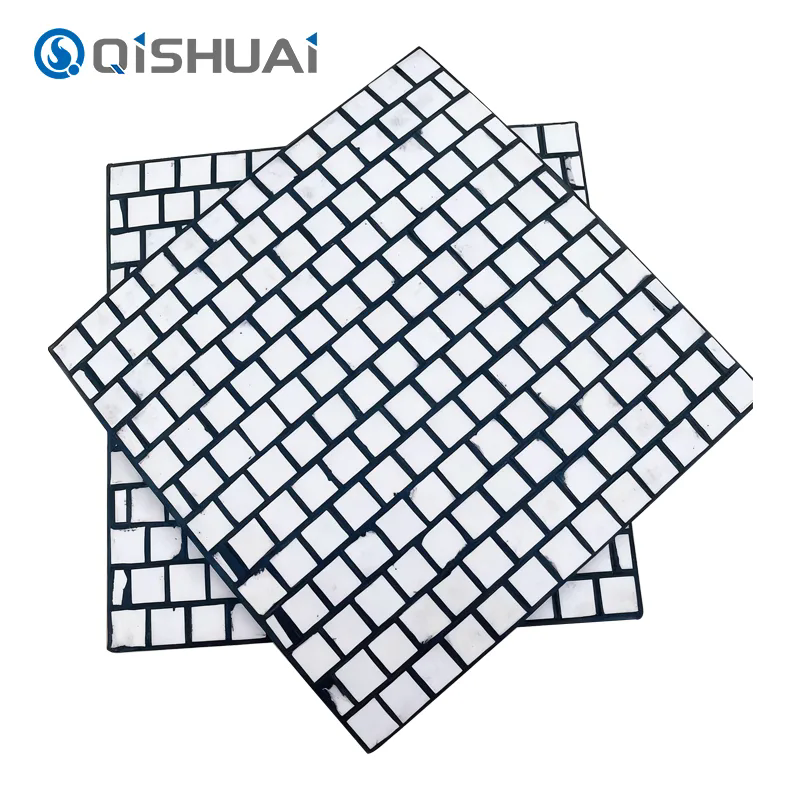
Table of Contents
- 1. How Does Ceramic Rubber Liner Address Industrial Wear Challenges?
- 2. How Are Ceramic Rubber Liner Specifications Defined?
- 3. How Is Ceramic Rubber Liner Applied Across Key Industries?
- 4. How Is Ceramic Rubber Liner Evolving With Industry Demands?
- Ceramic Rubber Liner FAQ
Outline
- Material composition and engineering logic
- Technical parameters and performance indicators
- Application scenarios in heavy-duty environments
- Development trends and system-level integration
1. How Does Ceramic Rubber Liner Address Industrial Wear Challenges?
Ceramic Rubber Liner is designed to mitigate the complex wear mechanisms commonly found in industrial material handling systems. These mechanisms include sliding abrasion, particle impact, vibration-induced fatigue, and chemical exposure. Traditional steel liners often fail prematurely under such conditions due to localized wear concentration and limited shock absorption.
The ceramic component, typically alumina-based, provides extremely high hardness and abrasion resistance. The rubber backing functions as an elastic buffer, dispersing impact forces and reducing stress transmission to the substrate. This dual-material structure enables Ceramic Rubber Liner to maintain dimensional stability while extending service life in chutes, hoppers, transfer points, cyclones, and pipelines.
From an engineering perspective, Ceramic Rubber Liner supports predictable wear patterns, which simplifies maintenance planning and reduces unplanned downtime. Its modular design also allows selective replacement, improving lifecycle cost control.
2. How Are Ceramic Rubber Liner Specifications Defined?
Specification of Ceramic Rubber Liner is driven by operating conditions rather than a single performance metric. Engineers evaluate material velocity, particle size distribution, drop height, operating temperature, and chemical exposure before selecting liner parameters.
| Parameter | Typical Range | Engineering Significance |
|---|---|---|
| Ceramic Material | 92%–95% Alumina (Al₂O₃) | Determines abrasion resistance and hardness |
| Ceramic Hardness | ≥ 85 HRA | Controls wear rate under sliding conditions |
| Rubber Type | NR / SBR / EPDM | Affects impact absorption and chemical resistance |
| Rubber Hardness | 55–70 Shore A | Balances flexibility and structural support |
| Bonding Method | Hot vulcanization | Ensures long-term ceramic retention |
| Operating Temperature | -40°C to +120°C | Defines suitable application environments |
In addition to physical parameters, installation methods—such as bolt-on, adhesive bonding, or weld-backed systems—are specified to align with maintenance access and safety requirements.
3. How Is Ceramic Rubber Liner Applied Across Key Industries?
Ceramic Rubber Liner is widely adopted in industries where material flow reliability directly affects production efficiency. In mining operations, it is commonly installed in ore chutes, conveyor transfer points, and beneficiation equipment where abrasive particles are transported at high velocities.
In power generation and cement plants, Ceramic Rubber Liner supports ash handling systems, coal chutes, and clinker transport zones. Its vibration-damping properties contribute to reduced noise levels and improved structural integrity of supporting equipment.
Bulk ports and steel plants use Ceramic Rubber Liner to protect hoppers and loading systems exposed to continuous material impact. The liner’s resistance to moisture and corrosion further supports long-term outdoor operation.
4. How Is Ceramic Rubber Liner Evolving With Industry Demands?
As industrial systems move toward higher throughput and automation, Ceramic Rubber Liner development is focusing on precision-engineered tile geometries and optimized rubber formulations. Digital wear monitoring and predictive maintenance strategies are influencing liner layout design to ensure even wear distribution.
Environmental and safety regulations are also shaping material selection, with increased emphasis on recyclable rubber compounds and low-dust installation processes. Custom-molded Ceramic Rubber Liner panels are becoming more common to reduce installation time and human error.
These trends indicate that Ceramic Rubber Liner is transitioning from a passive protective component to an integrated element of system-level reliability engineering.
Ceramic Rubber Liner FAQ
Q: How does Ceramic Rubber Liner differ from pure ceramic liners?
A: Ceramic Rubber Liner incorporates a rubber backing that absorbs impact energy, reducing ceramic cracking risk while maintaining high abrasion resistance.
Q: How long does Ceramic Rubber Liner typically last?
A: Service life depends on operating conditions, but properly specified Ceramic Rubber Liner often outperforms steel or rubber-only liners by several multiples in high-abrasion environments.
Q: How is Ceramic Rubber Liner installed in confined spaces?
A: Modular panels and adhesive bonding systems enable installation in restricted areas without heavy lifting equipment.
References
- ASM Handbook, Volume 18: Friction, Lubrication, and Wear Technology
- Mining Engineering Journal – Wear Protection Materials
- ISO 20808: Industrial Ceramics Performance Standards
In practical industrial applications, Ceramic Rubber Liner supplied by Qishuai is engineered to align with equipment-specific wear profiles and operational targets. Through material customization and technical support, Qishuai supports long-term system reliability and predictable maintenance cycles.
For detailed specifications, application assessment, or project consultation regarding Ceramic Rubber Liner solutions, contact us to discuss system requirements and operational conditions.
